We awakened to our last day on the South Island in Blenheim. Our ferry check-in time had been changed from 1:15 PM to 7 PM so we had a full day to explorer. Blenheim is the heart of Marlborough’s wine country, and winery tours might be in order if there weren’t any driving involved. However, we knew that we couldn’t change the ferry reservations so wine tours were really not an option.
Our Aussie friends from the Glentanner campground had highly recommended the Omaka Aviation Heritage Centre as a good touring option in the Blenheim area, so with a light rain falling we opted for an indoor experience.
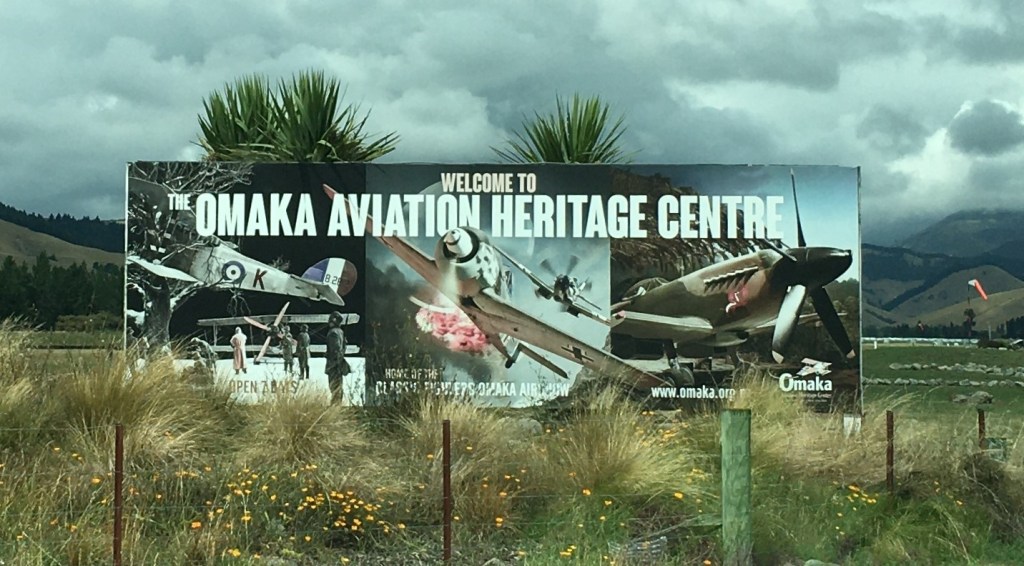
The Aviation Heritage Centre houses two collections of aircraft, one from each of WW I and WW II. Sir Peter Jackson, the director of the Hobbit and Lord of the Rings trilogies, was very central in bringing the exhibition to life. His generosity as owner of the Great War collection was key, and by all counts he was an enthusiastic participant in the process. Good on you, Sir Peter!
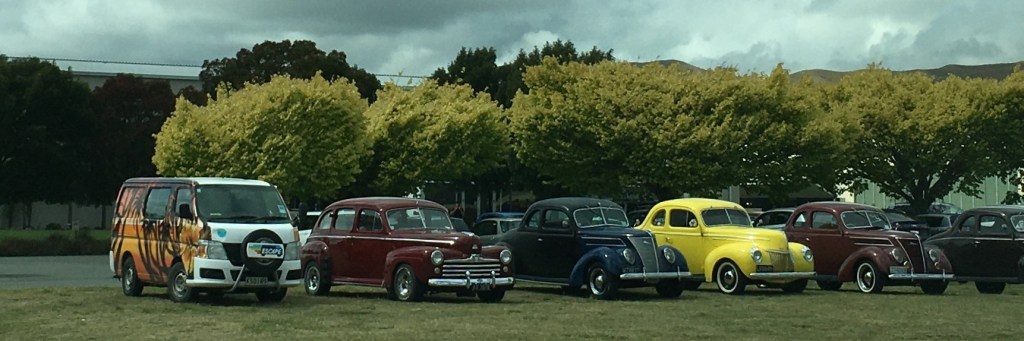
To start off our visit to the vintage aircraft collection, we were greeted by a very fine group of vintage cars in the parking area.
The Great War – WW I
We will start with the WW I collection. It is worth remembering here that the Wright brothers first flew on December 17th, 1903 and Louis Bleriot first flew the English Channel in 1909. World War I began only 5 years later and flight was still a dangerous novelty.

The Etrich Taube (Dove in English) was designed by Igo Etrich of Austria-Hungary in 1909 and first flew in 1910. It was in service from 1910 to late 1915. It pre-dated ailerons and used “wing warping” to achieve lateral control. Aircraft using ailerons would soon dominate.

Airco De Havilland DH-2 was a pusher plane with the engine and propeller behind the cockpit to avoid conflict between the propeller and the nose-mounted machine gun. It proved quite successful in combat and was in service from June 1915 until July 1917.
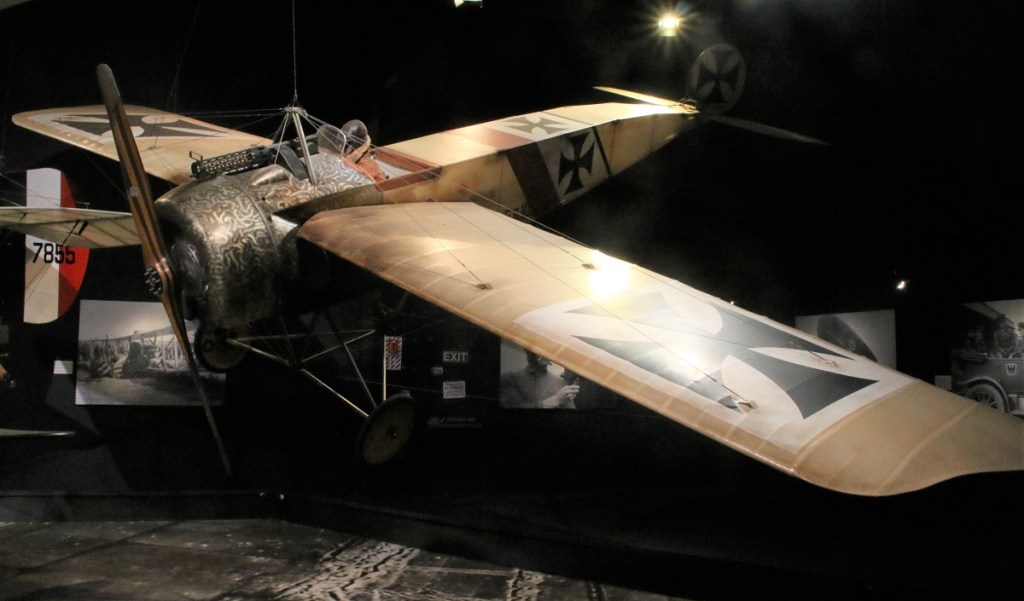
The Fokker Eindekker (monoplane) E.III was the first German aircraft to have the machine gun synchronized with the propeller. It was the principal combatant of the DH-2. It was in service from Dec 1915 to late summer 1916.
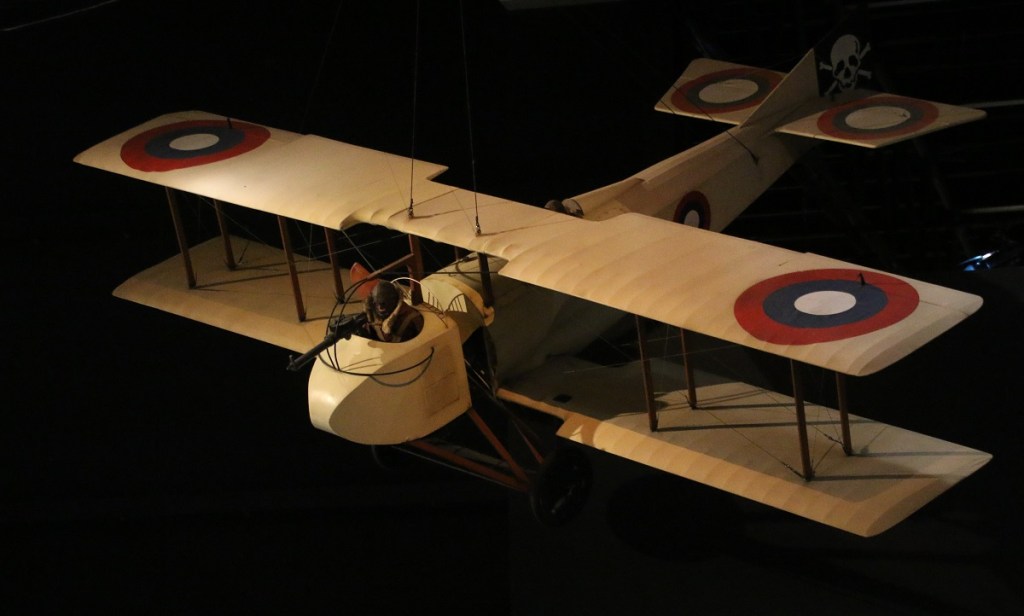
The Spad A2, shown here as a model, was developed before guns were synchronized with propeller. It moved the propeller, engine and pilot back placed a gunner compartment in front of the propeller. The British built a single aircraft and never deployed it. The French built 100 of them, 50 going in service in France and 50 in Russia, whose colours are shown here.

The Sopwith Triplane was a British aircraft brought into service in Dec 1916. Only 150 Sopwith Triplanes were built. The all-Canadian B Flight of No. 10 (Naval) Squadron, equipped with Triplanes, downed 87 enemy aircraft between May and July 1917. It was replaced with the Sopwith Camel biplane in late 1917.
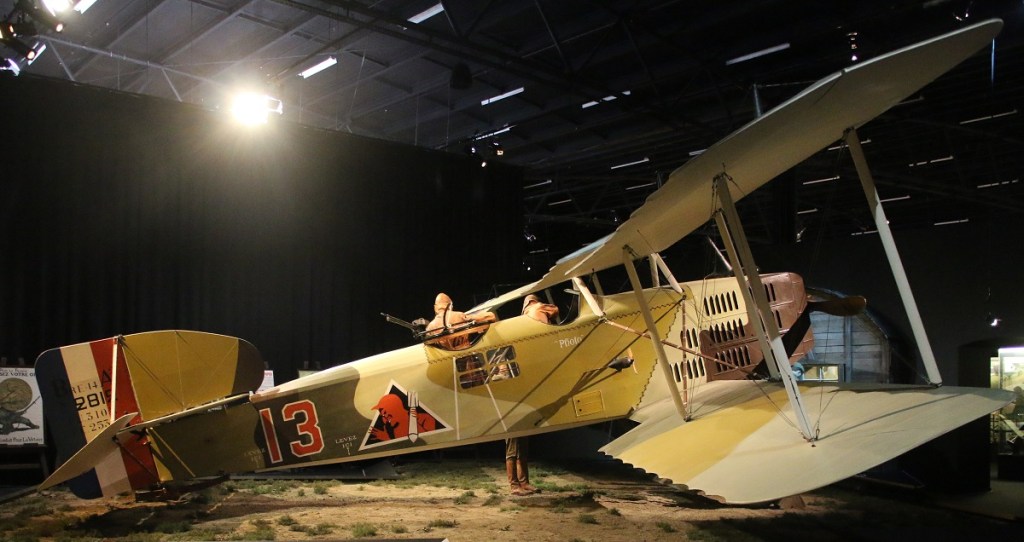
The Breguet 14 was introduced in May 1917 and was one of the most successful aircraft of the war due to it’s extensive use of aluminum. It was used as a fighter, a bomber and for reconnaissance. 5,500 were produced during the war and 2,500 thereafter. It remained in service until 1926.
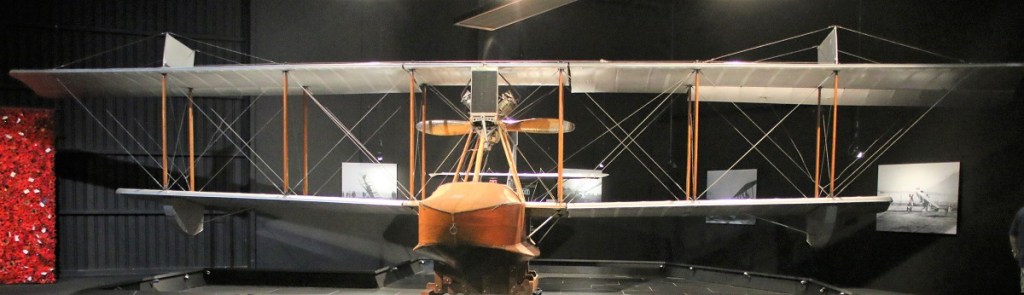
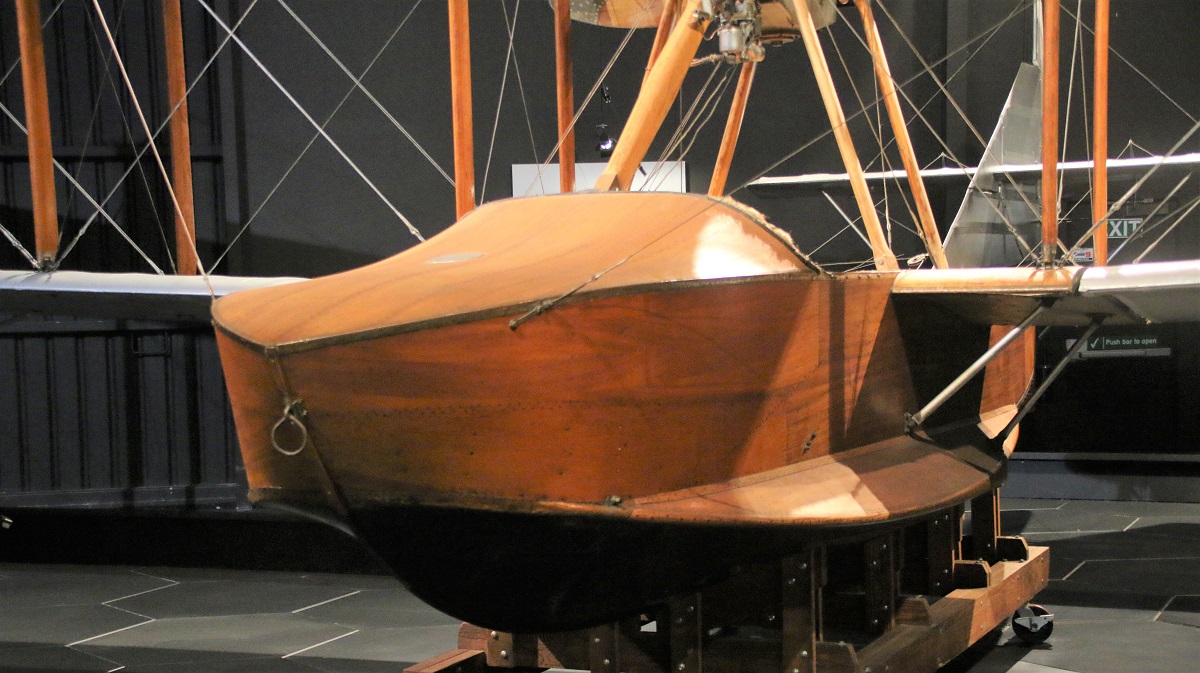
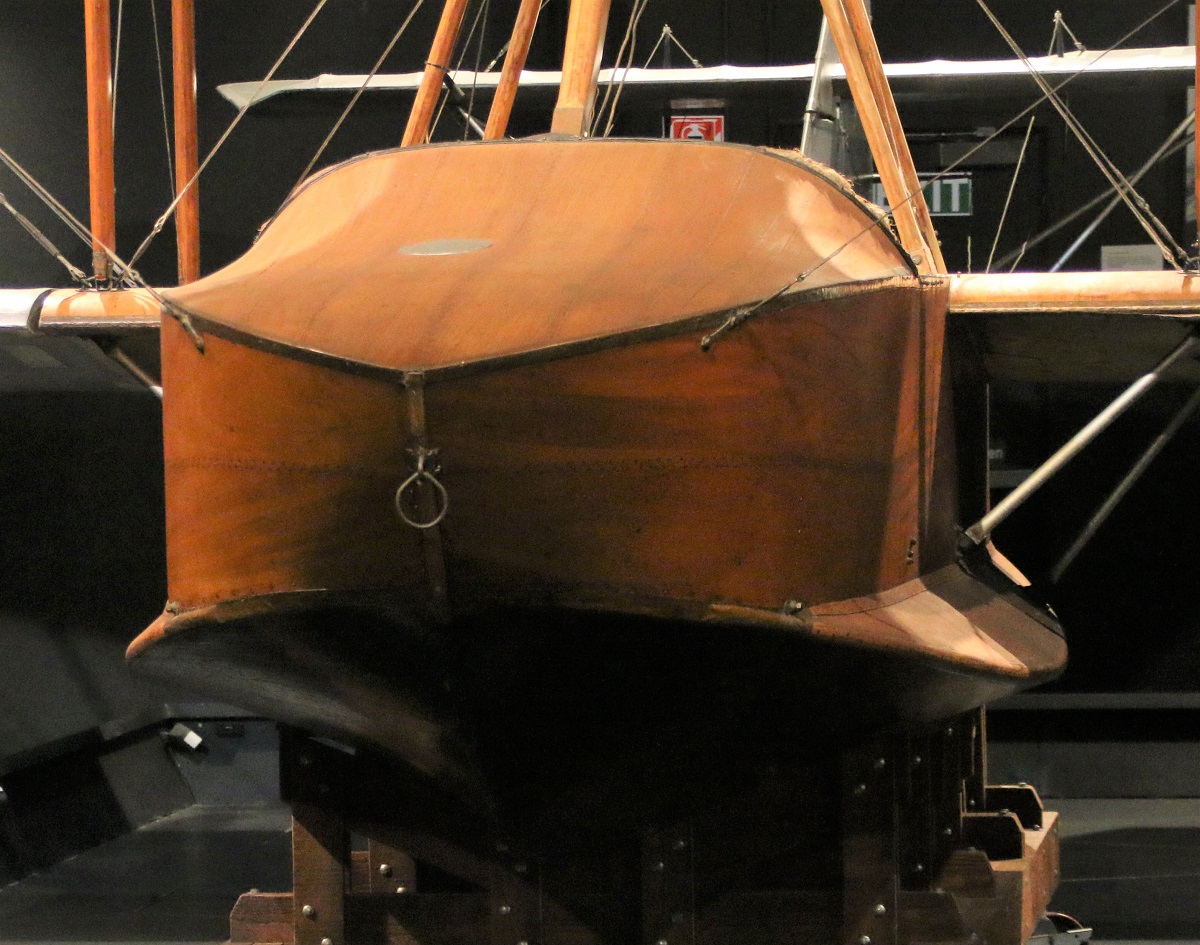
Glenn F. Curtiss was best known for perfecting the seaplane, first introduced in 1912. The Curtiss MF Flying Boat was an enhanced version of the original F model and was introduced in 1917. The US Navy had 22 in service by the signing of the Armistice in Nov 1918.
Having chartered seaplanes extensively during my career, I couldn’t resist taking some detailed photos of this baby.
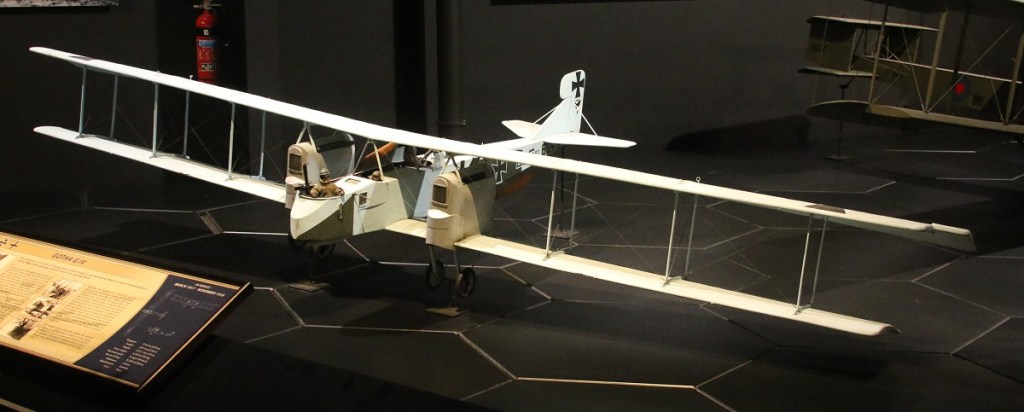
The Gotha G.IV (model shown here) entered service in March 1917 and replaced zeppelins as bombers. This allowed Germany to initiate a bombing offensive against England. The first mass attack was May 25, 1917 on Folkestone, Shorncliffe and Cheriton, killing about 95 people and injuring over 150. On June 13 the first attack on London caused the heaviest air raid casualties of the war, with 162 dead and 432 injured. The British had to upgrade air defense radically.

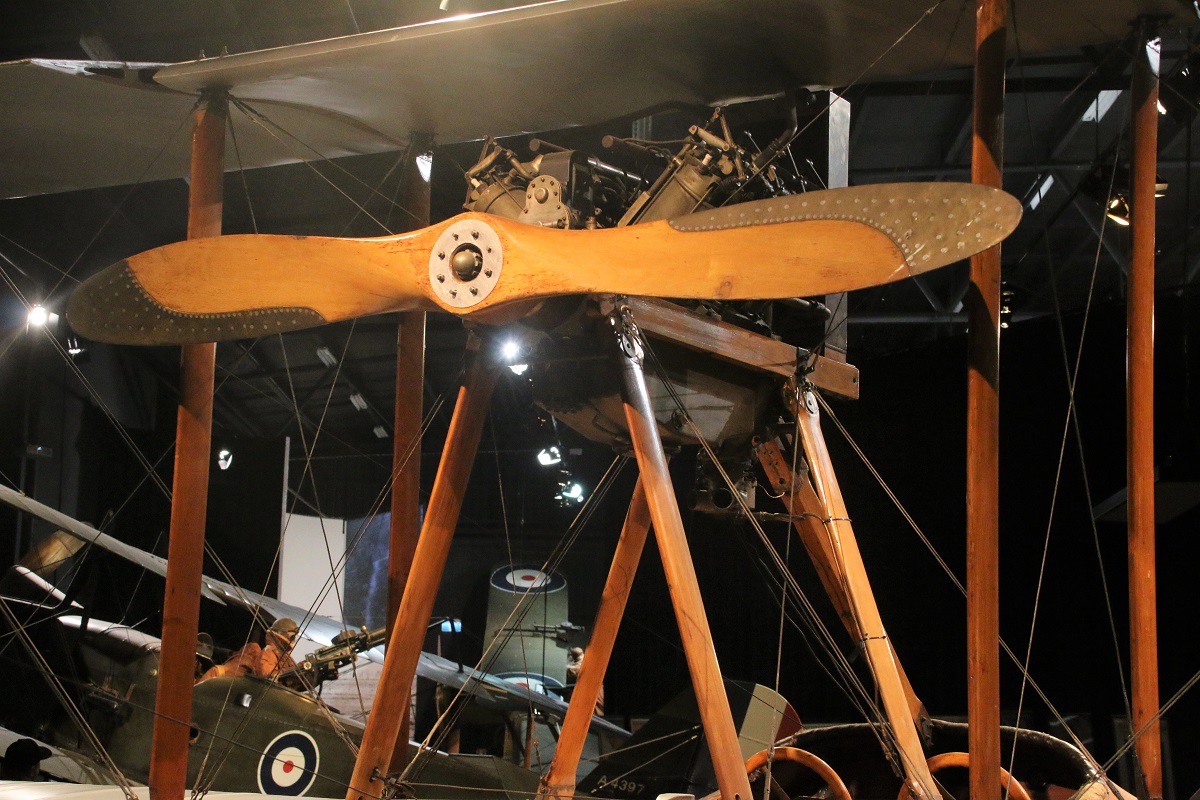
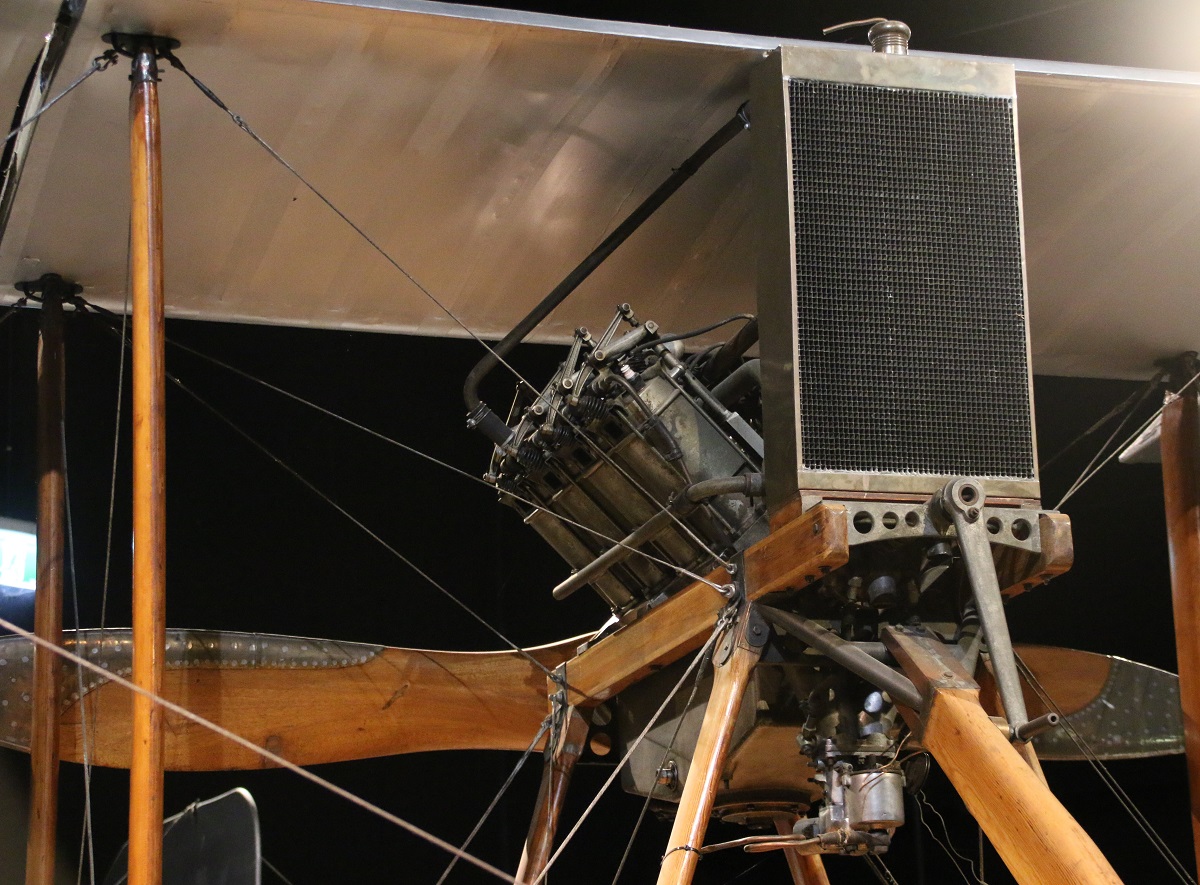
The Vickers Vimy (model shown here) was a very effective aircraft introduced just too late for use in the war. In 1919 it became world famous when English aviators John Alcock and Arthur Whitten Brown completed the first non-stop flight across the Atlantic Ocean June 14th to 15th. Five months later Australians Ross and Keith Smith flew their Vimy 17,700 km to complete the first England to Australia flight.
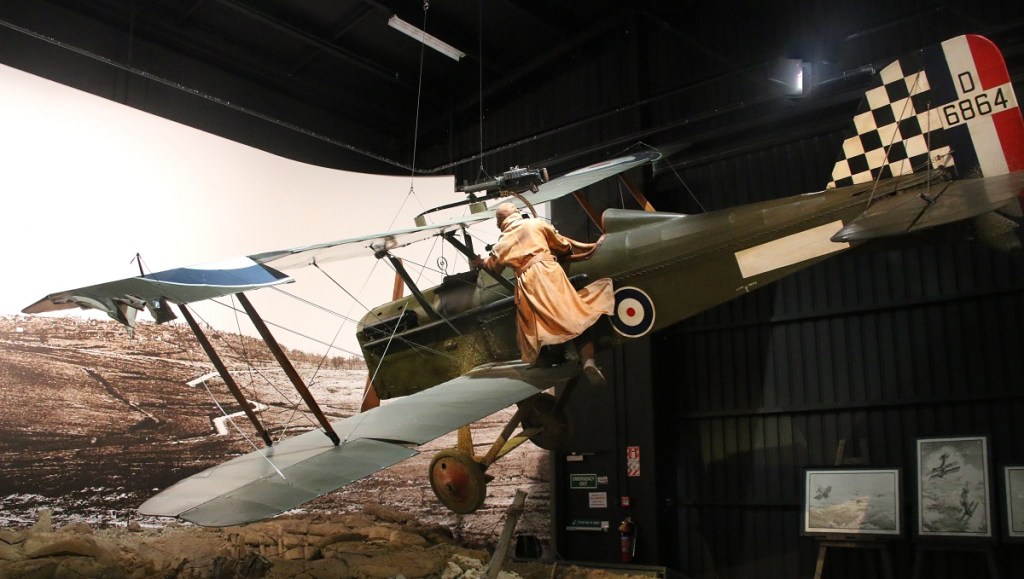
This photo, as well as showing a Royal Aircraft Factory S.E.5a aircraft, tells a story about New Zealand’s highest scoring “Ace” Lieutenant Keith Logan “Grid” Caldwell.
While in a dogfight at 7,000 feet over enemy territory he collided with another aircraft. His plane went into a dive and he gained partial control at about 5,000 ft. He climbed half out of the cockpit and found that by placing his left foot on the wing and holding onto the strut with his left hand he could stabilize the aircraft and fly it with his right hand still on the controls. He managed to just clear the frontlines. As he was about to crash, he jumped off, turned a few somersaults and jump into the allied trenches. He flew again the following day and survived the war. He was no wearing a parachute as the British military command had banned them thinking that pilots would bail out unnecessarily if allowed to wear them. All other combatant forces allowed them.
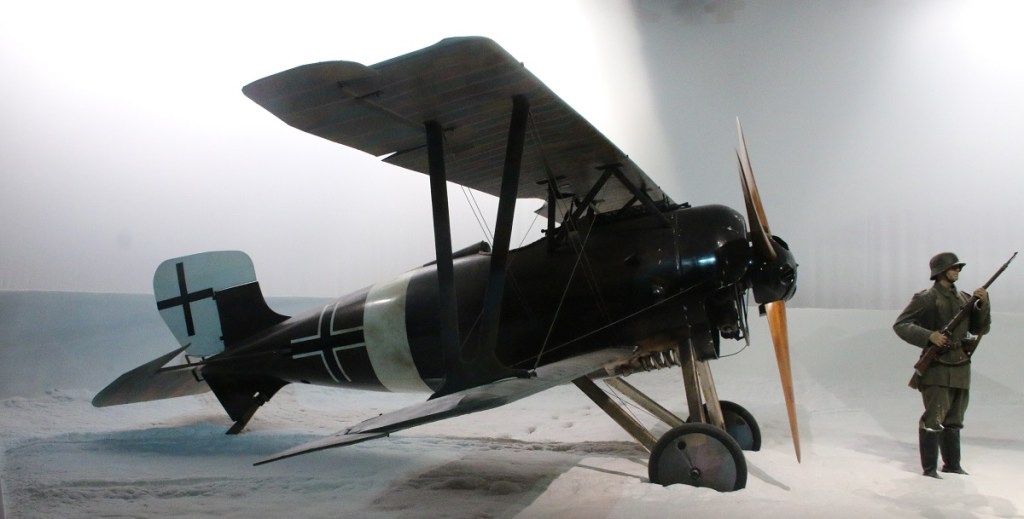
While not pretty, the Siemens – Shuckert D.IV was the most competitive small fighter produced by any combatant country. However, it was only introduced in August 1918 and only 60 were in service by the end of the war.
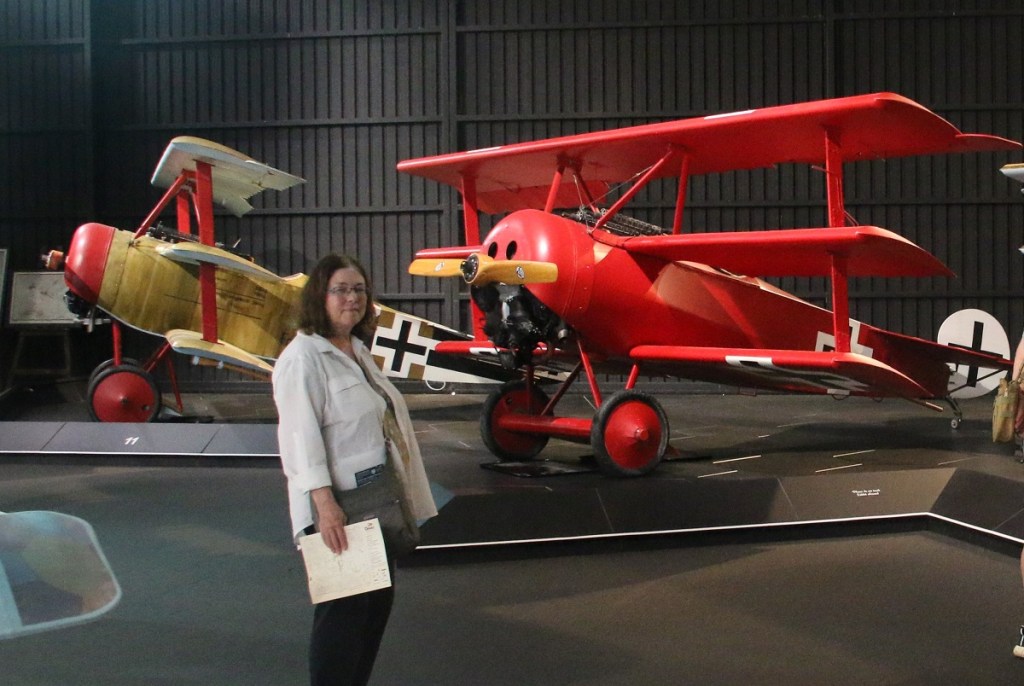
The Fokker DR.1 ‘Dreidekker’ Triplane was in service from August 1917 to May 1918. Tough it is the most remembered aircraft of WW I it was inspired by the Sopwith Triplane and was not an original German idea. The two shown here are replicas of the one flown by the Red Baron, Manfred von Richthofen and his younger brother Lothar. While the Baron was known for his triplane, most of his victories were actually accomplished from an all-red Albatros D.III biplane. The Baron died flying a triplane April 21, 1918, with the record number of 80 kills.
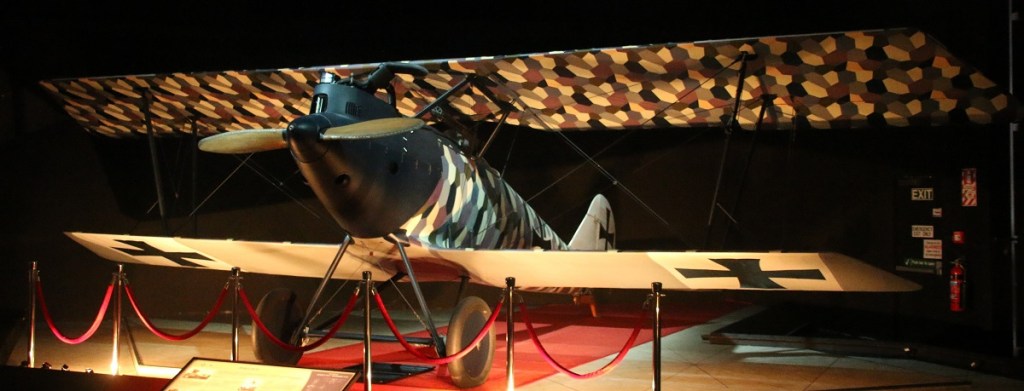
The Pfalz D.III was in use from Aug 1917 to Nov 1918. While one of the prettier aircraft of the era, it was a poor performer in many areas, except that it’s laminated plywood fuselage outperformed other aircraft in steep dives. This is a replica built for the 1960’s movie “The Blue Max”. It’s colour scheme originated from the movie, not the war.
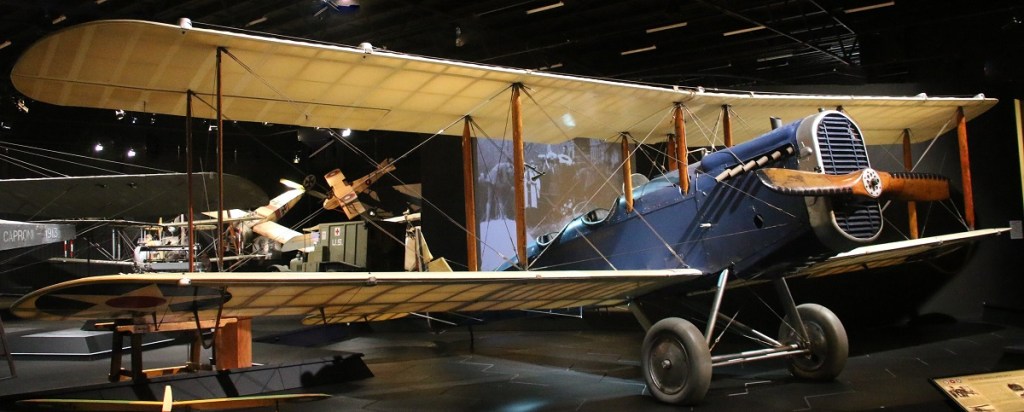
The Airco De Havilland DH-4, in use Aug 1916 until 1932, was designed for day-bombing and general reconnaissance. It’s success was partly because it could fly above the altitudes of all enemy aircraft. Thousands were built and it continued in use for many years. A young Charles Lindberg gained flying experience flying US mail in DH-4s.
Dangerous Skies – WW II
The aviation heritage collection focuses on fighter planes. As tensions mounted during the 1930s, participants in WW I began looking to design new replacement fighters for the biplanes still in use in the early 1930s. The Dangerous Skies display focuses on the most important fighters of WW II, and some interesting stories around WW II aviators.
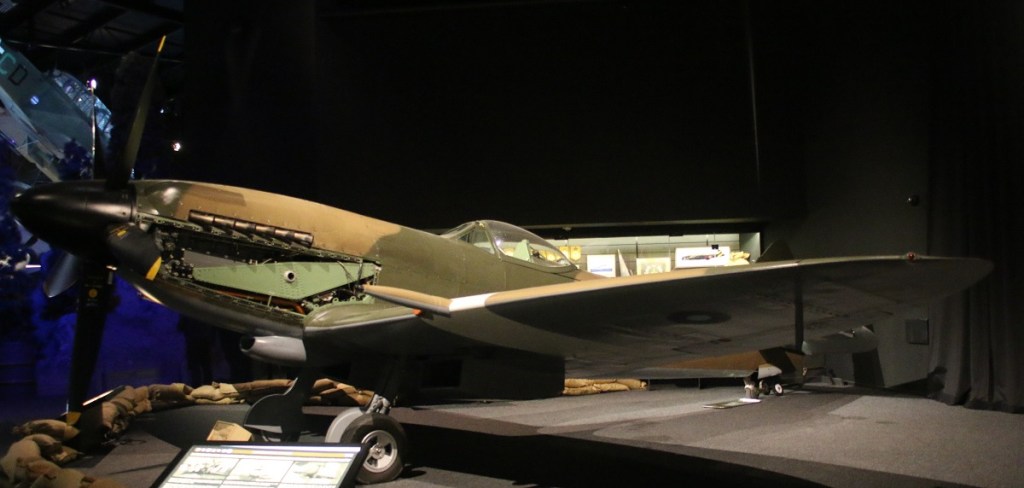
The Spitfire is a British single-seat fighter. Distinctive elliptical wings with innovative sunken rivets yielded reduced drag, a thinner cross-section and a greater potential top speed. Variants ranged from Mk 1 to Mk 24 with many subvariants. The original airframe, designed was for a 1,030 hp Rolls-Royce Merlin engine was strong and adaptable. Later versions used up to 2,340 hp Rolls-Royce Griffon engines and the Spitfire got better over it’s service life.

The Spitfire proved itself in the Battle of Britain (July–Oct 1940). Although the more numerous Hurricanes shouldered more of the burden of that battle, the Spitfire was faster, more maneuverable and had a higher ceiling. It had a lower attrition rate and higher victory-to-loss ratio.
After the Battle the Spitfire became the principal fighter of the RAF. It saw use in all theatres of the war.
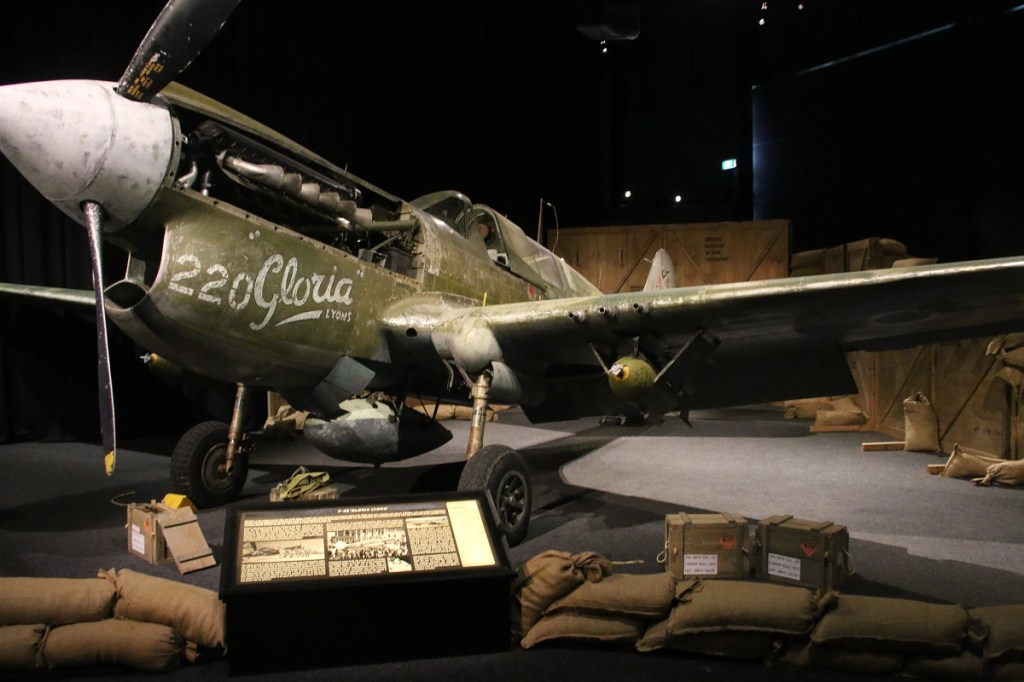
The Curtiss P-40 was inferior at high altitudes and saw little use in NW Europe. However, at lower altitudes it yielded superior performance and low cost and durability were big advantages. From 1941 – 1944, it was important in E&S Europe, the Middle East and N Africa, Asia and the Pacific. Over 200 Allied fighter pilots from the UK, Australia, New Zealand, Canada, South Africa, the US and the Soviet Union became aces (5 or more enemy planes downed) flying the P-40.

The Messerschmitt Bf109 was the principal German fighter used in the Battle of Britain. The Spitfire and the Messerschmitt 109 were highly advanced fighter planes and played key roles in World War II. While the Spitfire had the advantage in maneuverability and armament, the Messerschmitt had a higher top speed.
Germany had launched the Battle of Britain to gain air superiority over the RAF in preparation for a planned invasion of Britain. The fact that Germany was repulsed was a turning point in the war but the victory for Britain came at a great cost to both sides. In the 112 days from July 10th and October 31st, 1940, the RAF lost 1,542 aircrew killed; 544 fighter pilots, 718 aircrew from Bomber Command, and 280 from Coastal Command. Figures on German losses vary, but the consensus is that the Luftwaffe suffered 2,666 killed and 967 captured with 1,773 aircraft lost.
A speech by British Prime Minister Winston Churchill following the battle included the famous words “Never in the field of human conflict was so much owed by so many to so few”.

The Focke-Wulf FW190A 8 was introduced in Sept 1941 when four Fw190s engaged a flight of Spitfires and scored three kills. Fast, powerful and agile, the Fw190 soon began to rule the skies. Introduction of the Spitfire Mk IX in June 1942 reigned in the Fw190’s air superiority.
German aces who flew the Fw190 found it superior to the Messerschmitt Bf 109 except at altitudes above 8,000 m (25,000 ft). This deficiency was rectified by the introduction of the Fw190D-9 in late 1944 but this was too late to change the course of the war.

Bomber Boys’ Wheels
Bomber crews favoured British sports cars as crew cars. Most bomber crews had a crew car; if their plane didn’t come home, it passed to the crew of the replacement bomber. This 1934 model S.S.2 Jaguar by Swallow Sidecars was likely one of those.
With the Nazi connotations of SS, Swallow Sidecars renamed itself Jaguar Cars in 1945.
It is an often forgotten fact that the USSR was an allied force in WW II. While Stalin was a despot little better than Hitler, as allies the USSR made a range of major contributions to the allied victory. In aviation, the Soviets hold a couple of interesting records.

Yak-3
The Yak-3 was one of the best Soviet fighters of WW II. Robust and easy to maintain, its shortcomings were the poor reliability of it’s Klimov engine and a short range. The Yak-1 entered service in 1941 and the Yak-3 in late 1943. It was a markedly light aircraft with an excellent power to weight ratio and superb manoeuverability.
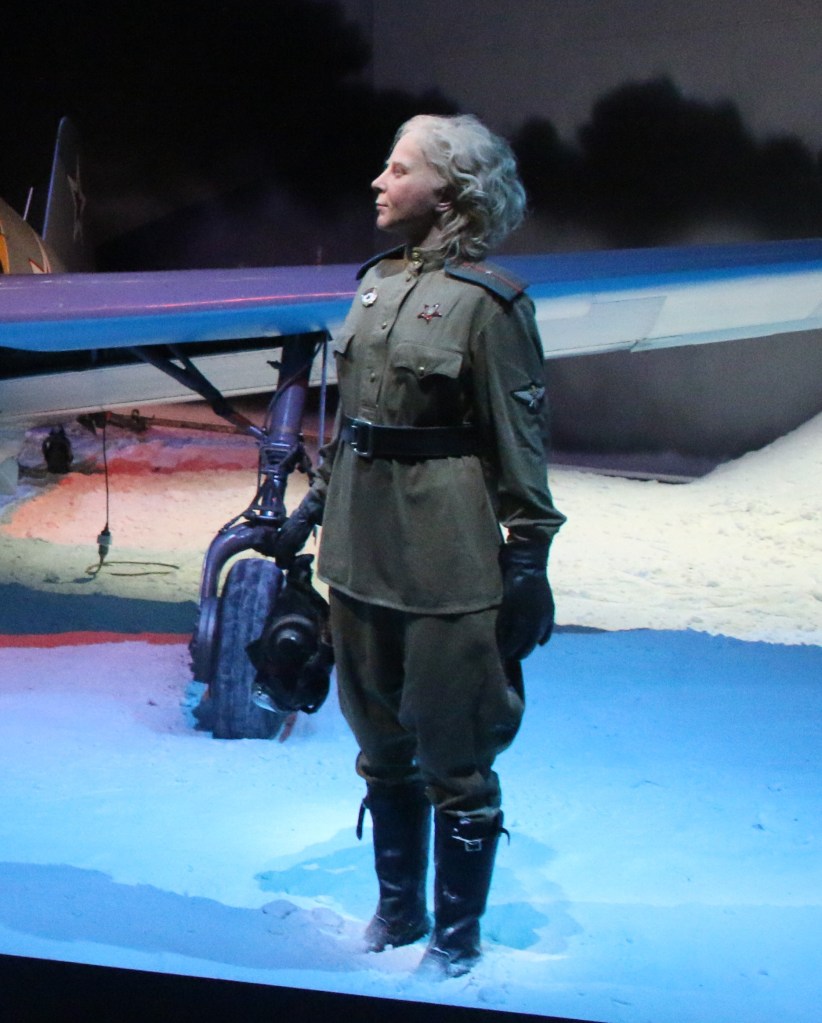
Lydia Litvyak – Female fighter Ace and Hero of the Soviet Union.
Born in Moscow in 1921, Litvyak developed an interest in flying early, piloting light aircraft at the age of 15. She became a flight instructor and by the time war broke out, had already trained 45 pilots.
At the age of 19 she became a fighter pilot in the Soviet Air Force. She is credited with twelve solo victories and four shared kills in 66 combat sorties over two years. She was the first female fighter pilot to shoot down an enemy aircraft, the first of two female fighter pilots who have earned the title of fighter ace and is still the record holder for the greatest number of kills by a female fighter pilot.
On Aug 1, 1943 (age 21) she was shot down near Orel during the Battle of Kursk as she attacked a formation of German aircraft. She flew Yak-1 fighters and died before the introduction of the Yak-3.
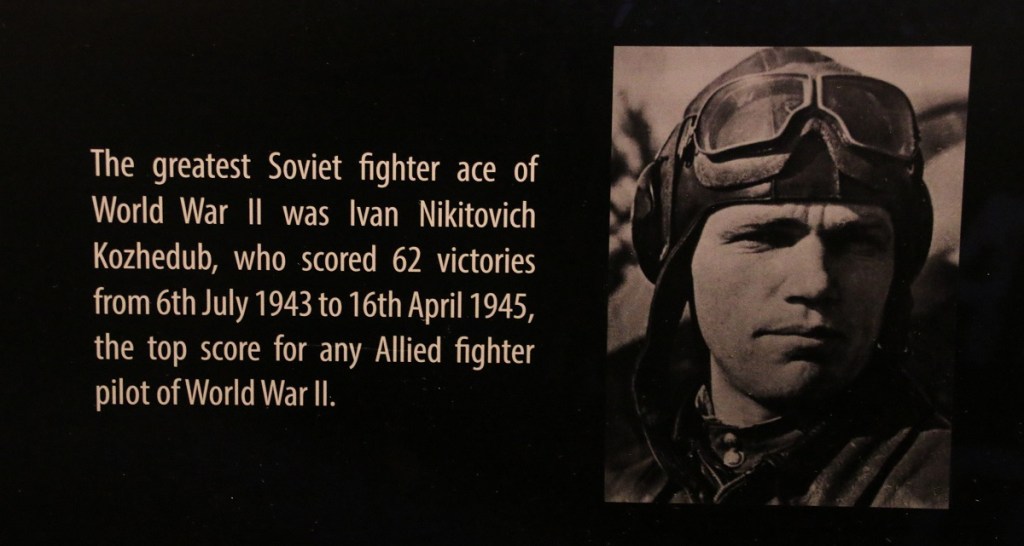
Ivan Nikitovich Kozhedub, Highest scoring Allied fighter ace of
WW II
Kozhedub, universally credited with over 60 solo victories, is considered the highest scoring Soviet and Allied fighter pilot of World War II. He is one of the few pilots to have shot down a Messerschmitt Me 262 jet, and the first Soviet pilot to have done so. He was made a Hero of the Soviet Union on three occasions (4 Feb 1944, 19 Aug 1944, and 18 Aug 1945).
About War
The Omaka Aviation Heritage Centre makes a very interesting presentation of the aircraft of the two World Wars and some of the personal stories involved. As the son of a Canadian allied air crew member from WW II, I am very appreciative of the sacrifices that the men and women of my parents generation made to preserve our right to live in a free world. In viewing the Omaka Centre, I am reminded that we should not lose sight of what war is.
War is when world leaders send the brightest and best to kill and/or be killed in order to settle a dispute. It only takes one belligerent to start a war, and the country or countries attacked have little choice to respond in kind. The following table presents a partial summary of losses on both sides in the Battle of Britain.
Battle of Britain, July 10th to October 31st, 1940, losses over the course of the battle, and daily average losses.
| Total | Daily | |||
| England | Royal Air Force | Dead | 1,542 | 14 |
| Germany | Luftwaffe | Dead | 2,666 | 24 |
| Germany | Luftwaffe | Captured | 967 | 9 |
| Germany | Luftwaffe | Aircraft Lost | 1,773 | 16 |
As it shows, commanders sent aviators aloft every day for the 110 days of the battle knowing that many would be lost on that day. It bears witness to the senselessness of war.
About the USSR as an Ally
The Soviet contribution was critical to the allied victory in WW II. However, when they reached Berlin they kept going west, partitioned Germany and claimed all countries between Germany and Russia as part of the Soviet bloc, starting the cold war.
In the Korean War they were our enemy. Following further training after the war Ivan Nikitovich Kozhedub was assigned to the 324th Fighter Aviation Division in 1949 and promoted to commander in November 1950. Shortly thereafter the unit was sent to China, where they trained Chinese and North Korean pilots. His division was soon active in the Korean War. While Kozhedub did not participate in combat, pilots of his division claimed 216 aerial victories in Korea from April 1951 to February 1952, while sustaining only 27 MiG-15 losses and nine pilots killed. So the highest scoring allied ace in WW II became our enemy the moment the war ended. The lesser of evils became the new evil.
Further witness to the senselessness of war.
Off to the North Island – a New Adventure
Following our visit to the Omaka Aviation Heritage Centre, we travelled to Picton to catch the ferry to Wellington and the North Island. While travelling mostly after dark, we had a very pleasant ride. We got off the ferry around midnight, and into bed at our campground about 1:00 AM.
 Grampafacts